
A Fine Parent

A Life Skills Blog Exclusively For Parents

  • Academy (Masterclasses)
  • Free Training
  • Articles
  • More
    • About This Site
    • Parenting Book Recommendations
    • Gift Guides
    • Contact

100+ Popular Gifts for Middle School Kids (Ages 11 – 14 Years Old)

by Mindy Carlson.
(This article is part of the Gift Guides series. Get free article updates here.)

gift guide middle schoolersIt was so easy to buy my kids toys when they were younger, but when they became middle schoolers I had no idea what they wanted!

Well, I did know they wanted tech, but wasn’t there other kinds of toys and gifts that middle schoolers would love?

So we did a ton of research.

I found gifts to encourage creativity, learning, self-discovery, reading, healthy eating, parent-child connection, and outdoor play.

And the best part?

All these are from Amazon, they all have a 4+ rating from tons of reviews and most are available through free 2-day prime shipping, so even if you are shopping at the very last minute, you might still be able to get them in time!
[Read more…]

How to Encourage Your Picky Eaters to Eat

by Kristin Khan.
(This article is part of the Positive Parenting FAQ series. Get free article updates here.)

Picky Eaters - MainOh, the things we believe before we have children!
My kids won’t be picky eaters.

They won’t live off fruit snacks and goldfish crackers.

My kids will joyfully eat everything I give them, and I’ll only give them healthy, organic, free-range, no additive, locally grown foods from BPA-free containers.

That soooo did not happen for me.

I tried to do all the right things and follow all the advice. I ate a wide variety of food when I was pregnant and nursing, so my baby would experience the flavor of different foods. I made homemade baby food, often using fruits and vegetables that I’d never tried before just to develop their palate.

It was fun and easy. Everything was going great. I had two babies who happily ate everything for the first year and a half.

Then, they became toddlers (I’m pretty sure a lot of horror stories begin that way). When my son started pushing, or rather, throwing, food off his plate, I realized I needed to get creative if I was going to continue feeding him healthy meals.

I was surprised by how quickly my son’s preferences changed. However, experts are not. In the journal, Frontiers in Pediatrics, Dr. Jason Lam reminds us that, “Picky eating is a relatively common behavioral problem that most children will eventually outgrow. Its roots stem from both environmental and genetic influences.”

Knowing it was a stage, like all others that arise in parenting, encouraged me to persevere and not take it personally. I didn’t fail as a parent… I just had to come up with a new plan.

To be the positive parent you’ve always wanted to be, click here to get our FREE mini-course How to Be a Positive Parent.

Dr. Lam advises, “Repeated exposure to new food in a non-coercive manner and in an environment that is both fun and rewarding may help overcome picky eating. Patience, time, and repetition may be the keys to success.”

After experimenting with my first son, I was more prepared once my younger son started rejecting foods, though I still had to modify some of my strategies. I also found I had to continue being creative to keep my older son interested in a variety of foods and not stuck in a beige colored food rut.

For our family, these 6 tricks, some of them a bit off-the-wall, worked best –

[Read more…]

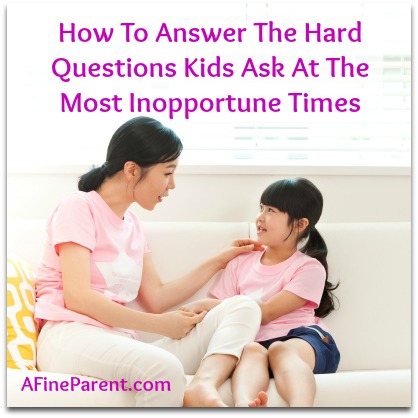
How To Answer The Hard Questions Kids Ask At The Most Inopportune Times

by Calleen Peterson.
(This article is part of the Positive Parenting FAQ series. Get free article updates here.)

questions_kids_ask_main_92926509“How come Betsy has two Moms?”

We were at my son’s therapy surrounded by Moms and other children when my three-year-old daughter popped that particular question. One of those Moms happened to be in the clinic at that moment.

I know I’m not alone.

On Facebook recently I saw a post from a mother asking how to deal with the hard questions.

You know, the extremely embarrassing questions our kids ask out of the blue.

Questions that leave you in shock that they’ve been brought up at all at this age.

Questions that they ask when it is the most inappropriate time to hold a discussion about the answer.

The ones that you might not have answers to yourself.

So when my child asked “Why does my friend have two Moms?” My reply was the classic, “Um, ah, let’s talk about it later when we get home.”

I needed a minute to think about how I wanted to respond to the question because I was not expecting this question from my 3 year-old. (Of course it would be my youngest who would ask this because she is extremely observant of social nuances around her.)

How many of you have had your child ask you one of these gems?

“Where did Grandpa go when he died?”

“What is sex?”

“Where do babies come from?”

“Why is that boy’s skin so dark?”

“Why is that girl missing a leg?”

Or the immortal question, “Is Santa Claus real?”

These questions take us by surprise. We don’t expect that question to come out of our child’s mouth right then. “Deer in the headlights” is probably one of the best descriptive phrases of this situation.

I’ll never forget when one of my children asked the question if Santa Claus was real. We were in the drive thru at Walgreens and had been waiting forever to pick up our medication.

[Read more…]

How to Protect Your Family from Screen Addiction

by Dr. Jill M. Richardson.
(This article is part of the Positive Parenting FAQ series. Get free article updates here.)

screen_addiction_main_61223985A few months ago, my phone required a reset in hopes it would respond better to its master. Afterward, I realized that all my notifications had been turned off.

No little red bubbles reminded me that someone had liked my Facebook post or retweeted my genius. I started to turn them on again, but then . . . I didn’t.

And I haven’t since.

I realized I was tired of 24/7 availability.

While we wring our hands trying to figure out how to help our children avoid electronic screen addiction, most of us have to admit it’s not only a problem for young people. Our buzzing, chirping, dinging world affects everyone—and families can work together to make themselves less slavish to its electronic siren songs.

Research would suggest that we start.

Researchers conducted a series of experiments with volunteers aged 18 to 77, requiring them to sit alone for fifteen minutes with no outside stimulation. Over half of the participants disliked being alone with their thoughts so much that they gave themselves mild electric shocks as a distraction during the 15-minute session of quiet thinking.

The average American spends a little over ten hours a day looking at screens—leaving precious little time for human interaction and play, two of the healthiest things we can do. That’s more than equivalent to a full time job.

Of course, some of that time is our jobs—I feel attached to this MacBook more hours than I like to admit, because screens are my job, but they’re also my addiction, if I’m totally honest. I should put them down after five—but I don’t always.

On a test of electronic addiction, I scored “moderately addicted.” Seeing that kind of statistic for myself isn’t OK, and it’s worse for our kids.

Expert psychiatrist Victoria Dunckley has created a test to see if we can spot the signs of screen addiction, with questions like:

Does your child become irritable when told it’s time to stop playing video games or to get off the computer?

Do you ever feel your child is not as happy as he or she should be, or is not enjoying activities as much as he or she used to?

Does your child prefer socializing online over face-to-face interactions?

[Read more…]

Understanding and Strengthening the School Counselor-Parent Relationship

by guest_author.
(This article is part of the Wisdom From the Trenches series. Get free article updates here.)

Parent and school counselorWhen you think of a school, you likely consider many different types of relationships there. The students are a priority, from their academic performance to their social development. For kids to be at their best, there must be healthy, strong relationships between student-teacher and school counselor-parent, along with many others. Let’s focus on the school counselor-parent connection, focusing on providing the environment that the child deserves, now and in the future. For those who wonder how to become a school counselor and parents and others in the educational system, this discussion is an important one.

Why Including Parents is Important for Counselors to Do

When school counselors include the parents in their bond with a student, they have the potential to make the relationship an amazing one. Supporting the entire family and providing clear communication to all can benefit the child immensely moving forward. For that reason, there are discussions about family involvement in the classroom when learning how to become a school counselor

[Read more…]

  • « Previous Page
  • 1
  • …
  • 32
  • 33
  • 34
  • 35
  • 36
  • …
  • 80
  • Next Page »

Disclaimers and Such:
Fair Warning: While none of this is professional advice, it is powerful stuff and could potentially change your life!
This site contains affiliate links. Pictures are either Creative Commons licensed or through Fotolia.
Click here to read our terms of use and privacy policy.