A Fine Parent

A Life Skills Blog Exclusively For Parents

  • Academy (Masterclasses)
  • Free Training
  • Articles
  • More
    • About This Site
    • Parenting Book Recommendations
    • Gift Guides
    • Contact

Search Results for: journal

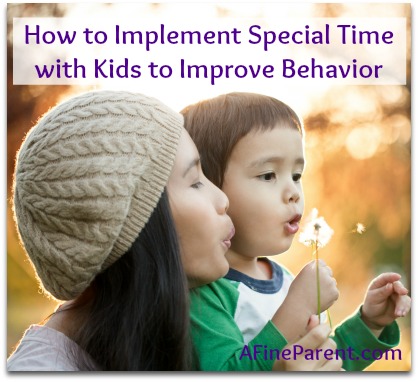
How to Implement Special Time with Kids to Improve Behavior

by Mary Ann Blair.
(This article is part of the Positive Parenting FAQ series. Get free article updates here.)

special time with kids - main“Noooo!”

His high-pitched shout echoed down the hall.

“Buddy, please just go put on your shoes. I don’t want to ask you again.”

“I don’t want to!”

I sighed loudly as I braced myself for yet another showdown.

My five-year-old had been pushing all my buttons for weeks. He was cranky and would balk at the simplest requests. The sass had reached an all-time high.

On top of that, he was incredibly needy even though we were spending almost every day together.

I was at my wits end, and I felt like our relationship was really struggling. It was one of those seasons in parenting when I was at a complete loss for what to do next, even though I knew something had to change.

Ever been there?

If you have, you know it’s not a fun place to be.

It was during this time of desperately searching for some solution, when a parenting webinar led me to the work of Dr. Laura Markham and her book, Peaceful Parent, Happy Kids: How to Stop Yelling and Start Connecting.

The title immediately caught my eye. I longed for a peace-filled home, and of course I wanted happy kids. What parent doesn’t?

Sheer frustration had me yelling way more than I ever imagined I would, and I knew the connection with my son was suffering greatly as a result. This book couldn’t arrive fast enough!

I dove right in, and when I read the section about spending special time with kids, a light bulb went off.

I realized although my son was around me for a significant part of each day, we often weren’t spending quality one-on-one time together. With his little brother to care for, along with the general busyness of life, I just wasn’t paying enough attention to him. (It pains me to say that aloud.)

His neediness that, at times, was downright exhausting was a clue. His defiance and cranky attitude? Also clues. I was not giving him the connection time that he needed.

I didn’t know if having special time with my son was going to bring harmony back to our relationship, but I was eager to give it a shot.

[Read more…]

How to Teach Kids the Value of Money in the Age of Consumerism

by Ruth Wanjiru.
(This article is part of the Positive Parenting FAQ series. Get free article updates here.)

teaching_kids_about_money_main_14273921.jpgA lot of times, I find myself struggling with the urge to buy that new trendy phone (which I don’t need anyway).

Or eating out at lunch rather than bringing one in from home.

Or buying my kids a toy when they’ve been especially good.

Sound familiar?

Early last week I attended a personal finance seminar that left me thinking. Would I want my kids to manage their finances like I do? How am I doing in keeping up with my saving goals? Am I going to have enough for those big things I need? How about retirement? And what am I teaching my kids about spending versus saving money?

In our daily lives, we are bombarded by multiple messages urging us to spend. From TV commercials to web banner ads, the message is the same: BUY ME!

With consumerism being normalized as a vital part of our daily lives, the time is ripe to teach our kids the value of money as early as their preschool years.

There are many reasons why starting early is important. One, kids absorb knowledge faster at this age. They then form habits that they take with them into their adulthood.

Alfred Adler, in his groundbreaking individual psychology theory, remarks that a child’s attitude towards the problems of life is governed by their childhood experiences. In fact, a Cambridge University study shows that adult money habits are set by age seven.

Secondly, we do not want our children to be part of the negative credit card statistics. In a personal finance survey for college students by Lend EDU, 59% of students surveyed graded themselves below average in successfully managing their finances. 41% of the 455 surveyed saved less than 10% of their monthly income.

Teaching kids the value of money helps with the setting of specific savings goals during their adult life. Without specific goals, saved money can easily be withdrawn for impulse buying and overspending.

Finally, you never know what is going to happen. Recessions happen. Employers go out of  business. Cars need repairs. The roof needs replacing.

There are literally a thousand different emergencies that can happen and all of them require money. If you don’t have that rainy day fund saved your credit cards are going to take a hit and then you’re going to have to dig yourself out of the hole.

To be the positive parent you’ve always wanted to be, click here to get our FREE mini-course How to Be a Positive Parent.

It is therefore important to teach our kids the value of money. These 4 tips will get you started on the beautiful journey to teaching consumer smarts.

[Read more…]

How to Teach Your Anxious Child to Be Her Own Advocate

by Melissa Moens.
(This article is part of the Positive Parenting FAQ series. Get free article updates here.)

anxiety_in_kids_main_191421768“Daaaaaaad!!!!! Get it!!!! NOW!!!!”

My 3 year old points to the street, where my husband had just set out the trash, at the bags of aqua green flitting in the wind.

She can’t stand it. The sight of anything BLOWING. It fills her with anxiety and dread. You can see it on her face. My husband has to run out to the curb and retrieve the bags he just moments before hefted toward the street.

When he comes back in through the door, her little body relaxes and she goes about her business. I look at my husband and give a whisper of thanks.

I, too, was just there last week. Running like an idiot through the parking lot of Walmart to chase a flyaway bag because I thought she was going to have a heart attack.

Or the time I heard screaming coming from the bathroom. “MAKE IT STOPPPP!”

I thought something terrible had happened.

I raced into the bathroom to nothing spectacular, much to my relief. Just the towels on the towel bar blossoming slightly upward from the force of furnace air emanating from the register.

Then it all came back to me. The garbage bags. The parking lot. The wind. All of these factors equaled one thing and one thing only: they made my girl ANXIOUS.

[Read more…]

How to Make Sure You Are Speaking Your Child’s Love Language

by Stephanie Hedrick-Caldwell.
(This article is part of the Positive Parenting FAQ series. Get free article updates here.)

love_languages_explained_main_36659191The air was cool, so crisp that a deep lungful through the nostrils left a slight tingle.


Outside was grey, the unmistakable smell of rain draped over the earth; the clouds ready to release their unrelenting load. The open windows allowed the fresh, clean breath of autumn to blow throughout the house; a flawlessly sweetened cup of coffee and an unopened magazine waited patiently on the table.

This was the perfect day for a pair of joggers and an oversized sweater. The kids awoke one by one and filled the kitchen with the sounds breakfast; a pop of the toaster and clanging of bowls and spoons meant the day had begun.

Soon afterward the realization that the homeschool lessons could wait, and the day could be filled with Netflix documentaries became an exciting reality. Everyone settled on the couch, but one.

The youngest child pushing and shoving all her siblings to reach Mom’s lap; completely unsatisfied until she was securely positioned in this place of honor.

This child shares more with her Mother than just a strong will and piercing blue eyes. They share a love language.

5 Love Language BookYears ago, when I was pursuing my bachelor’s degree in psychology, I was introduced to the writing of Dr. Gary Chapman. His book, The Five Love Languages of Children, changed my parenting style completely. Here’s how.

[Read more…]

How to Protect Your Child from Perfectionism

by Lisa Parkes.
(This article is part of the Positive Parenting FAQ series. Get free article updates here.)

perfectionism_in-children_main_191422790.jpgIn my doll’s tea set, there were no cups without saucers.

If the mudguard on my bike was crooked or rattled, I’d insist that my Dad repair it before I could ride my bike again. (We jokingly called it ‘Rattly Mudguard Syndrome’ (RMS) in our house when things weren’t quite how they should be.)

My floral duvet could be nothing other than symmetrically placed on my bed each night. I had cleverly mastered the art of measuring it by becoming a snow angel centered in my bed to see where the duvet fell across my legs. Only then could I sleep.

Well, it took me a long time to drift off as I mentally prepared and played out everything I had to remember for the next day. Forgetting was not an option.

As a child, it was a standing joke in our house that I liked things a certain way.

At school, I refused to complete an entire page of sums, but instead would go to the teacher and ask they mark each one. I had to know that I’d got it right before I continued.

As I got older, exams would send me into meltdown as I didn’t have the luxury of time to perfect my work.

Every mistake felt like a kick in the guts. Every mistake was a reminder of how wrong I was as a person. I would exhaust myself avoiding that shameful heavy feeling which repeatedly reminded me that I wasn’t good enough.

[Read more…]

  • « Previous Page
  • 1
  • …
  • 10
  • 11
  • 12
  • 13
  • 14
  • …
  • 23
  • Next Page »

Looking for Something Specific? Search Here…

Disclaimers and Such:
Fair Warning: While none of this is professional advice, it is powerful stuff and could potentially change your life!
This site contains affiliate links. Pictures are either Creative Commons licensed or through Fotolia.
Click here to read our terms of use and privacy policy.