A Fine Parent

A Life Skills Blog Exclusively For Parents

  • Academy (Masterclasses)
  • Free Training
  • Articles
  • More
    • About This Site
    • Parenting Book Recommendations
    • Gift Guides
    • Contact

Roots and Wings: How to Give Your Kids The Best Gift Ever

by Cally Worden.
(This article is part of the Strong Kids series. Get free article updates here.)

Roots and Wings: How to Give Your Kids The Best Gift EverSo here’s a parenting conundrum to kick off your day:

Q: How do we keep our kids grounded and secure?

So many possible answers. But the truth behind all of them is really very simple:

A: We give our kids wings and show them how to be free.

This is one of the primary contradictions of parenting – the delicate juggling act between setting limits, while simultaneously encouraging independence.

Finding a way to give our kids both roots to keep them grounded and wings to soar, is quite possibly the best gift we parents can ever give.

It begins as soon as our children start to move unaided. And it’s a paradox that will haunt many of our parenting decisions until they leave home. And beyond.

Finding the balance between boundaries and freedom is key to raising strong kids who will thrive no matter what. It’s the difference between raising a child who is tentative, and one who is self-assured. One who will take life’s knock-backs hard, and one who will meet challenges with confidence.

No pressure then.

It’s enough to tie your own emotions in knots. Not to mention your stomach. Mine is all tangled just thinking about it. So just how do we find a way to give our kids this precious gift?
[Read more…]

10 Steps for Teaching Your Kids How to Be Assertive

by Deidre Parsons.
(This article is part of the Strong Kids series. Get free article updates here.)

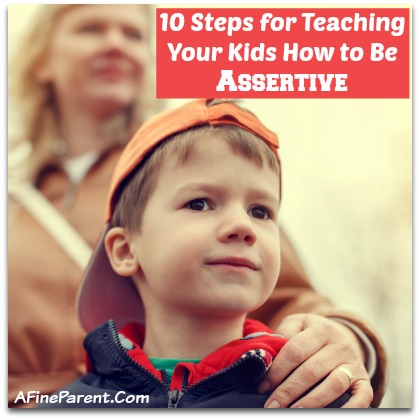
How to Be Assertive - Main PosterAre you struggling with a child who has difficulty standing up for himself?
Maybe you’re worrying about your own level of assertiveness and how to model strong behavior?

I am the child of a mother who blurred the lines between where she ended and where I began. I grew up with very little understanding of personal and emotional boundaries.

I was expected to agree with my mother’s opinions without question. If I didn’t, there were consequences, usually in the form of yelling or loss of a privilege as punishment for my “disrespect.”

I rarely spoke up for myself or shared my personal feelings because I was afraid of what might happen if I did.

As an adult, I am still hesitant to assert myself with my friends, family, coworkers, or even casual acquaintances.

I have struggled with a lifetime of silence in which I hesitate to speak my mind for fear of negative consequences or withdrawal of love by people close to me. I struggle with feeling responsible for the feelings of others and avoid saying or doing something that I think might upset someone else.

I have been told that these were positive traits because I am “sensitive to others” and “have a good heart.” But I have paid a steep price for my silence in the forms of low confidence, low self-esteem, and severe passivity.

Now that I am a mother, I’m trying to learn how to assert myself and set appropriate boundaries in my relationships. My ultimate goal is to teach my daughter what I learn about assertiveness so she can live a less anxiety-ridden life.

I have discovered that there are many like me who were raised “to be seen and not heard” and who want to stop the cycle of passivity and raise children who advocate for themselves.

Over time, I have learned that there are 10 key steps to helping children learn to be assertive. Do I always implement them with flawless precision? I’m afraid not.

But I’m doing my best to unlearn the behaviors I acquired in childhood and raise an assertive child who possesses unwavering self-respect. That’s the best we can do right?

OK, here we go –

[Read more…]

How to Prepare Your Kids for Effectively Dealing with Frustration

by Kerrick Lucker.
(This article is part of the Strong Kids series. Get free article updates here.)

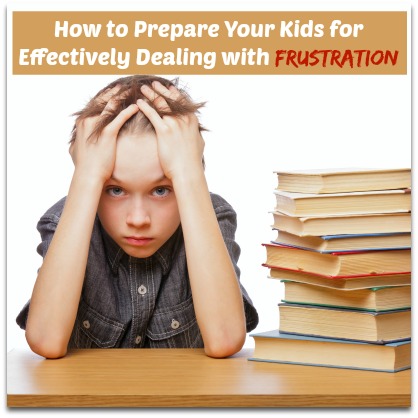
Dealing With Frustration - Main PosterAmelia is having a problem.

I can tell from across the room, where I’m addressing another student’s question about their circuit project. Her face is getting redder and redder, her eyes are starting to get puffy, and she’s breathing very fast.

Amelia is eight, and every problem is the biggest problem of her life—even one as simple as a broken bit of copper wire.

I know what will happen next—if she doesn’t get to replace her wire right now, she’ll start to scream and sob uncontrollably. She might get out of her seat and throw her project materials on the floor.

In short, she’ll lose it and create an intolerable class disruption, all because her emotional response to momentary frustration is crashing out of control.

I’m worried for her, because unlike a broken wire, this emotional cascade can wreck her experience of school and jeopardize her future. Her panicky reaction to perfectly valid feelings of frustration can lead to behavior issues with real academic consequences.

Except today, Amelia takes a deep breath.

She slows down her breathing, and though I still see the edge of tears in her eyes, her face starts to return to its normal color. She puts up her hand and waits for me to call on her.

“I’m frustrated,” she declares. “My wire broke, and I can’t finish the circuit.”

“What can you do to fix it?” I ask her.

She thinks. I give her some time, letting the silence spool out for a minute or so. I see her frustration begin to shift into curiosity. She’s fidgeting with a bit of the aluminum foil we’ve been using to make very simple switches.

“If I wrap the pieces of wire together with some aluminum foil, will it make them work?”

“That’s a cool idea, Amelia. I like the way you’re thinking. Please try it and let the class know how it works, because I bet someone else will have the same problem and you could help them.”

Amelia is excited to have something to contribute. She has in fact found a workable solution—not the most elegant, but one of her own design.

Two weeks ago, this exchange would have been inconceivable.

[Read more…]

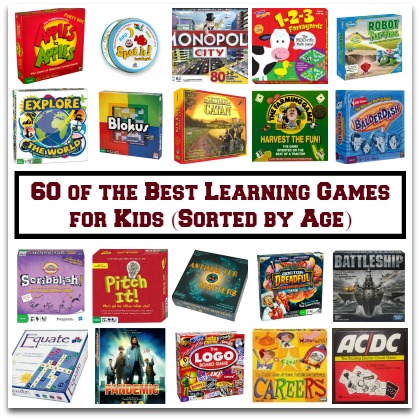
60 of the Best Learning Games for Kids (Sorted by Age)

by Lisa Tanner and Team AFineParent.
(This article is part of the Gift Guides series. Get free article updates here.)

Learning Games for Kids Collage - resizedAre you struggling to pick the perfect gift for a child this year?
Let me help.

As a certified teacher, and a homeschooling mom to seven, I really believe in using learning games for kids. We play them regularly. With over 100 games in our collection, I think I’m officially a board game addict.

Here’s why:

  • They’re fun. And what better way to learn than to have some fun?
  • They encourage soft skills. Communication. Collaboration. Problem Solving. These soft skills are crucial for success in the real world. These skills are the ones most encouraged through playing games.
  • They’re great learning resources. English/Language arts. Math. Science. Social Studies. They all go from “boring” subjects to “can we do that again tomorrow” subjects when you’re playing.
  • They’re not on a screen. I struggle with limiting screen time for my kids. Between the computer, the TV, and the various gadgets, our home feels overrun by media at times. Games focus on real-world interactions instead of digital ones. I like that.

But with so many games out there, which ones should you pick for your child? Which ones offer the most fun while still being educational? What do they teach? How can you make the most of them while playing, and connecting, at the same time?

That’s what this list is for. These are all games I either own or have on my personal wish list. At least three of them will be gifts at my house this December!

We’ve got many games to cover, so let’s jump right in.

Editor’s Note: Using play to teach is a popular positive parenting technique. If you’re new to positive parenting, or want to learn more, click here to signup for our FREE mini-course How to Be a Positive Parent.

Learning Games for Kids in Preschool

Preschoolers are little sponges, constantly absorbing information about life as they play. Guide their brains in development with the following games.

English/Language Arts

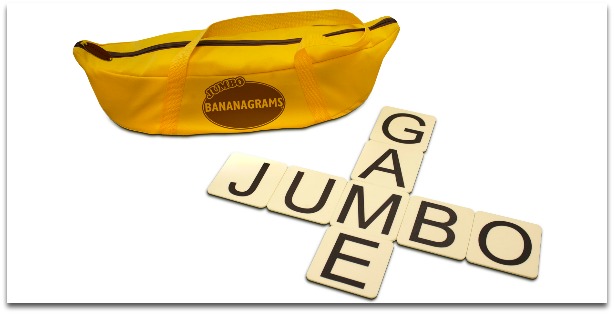
Jumbo Bananagrams

Learning Games for Kids in Preschool -Jumbo_Bananagrams_resizedWhat can you do with a bag full of 3-inch square tiles with individual letters printed on them? Lots!

Challenge your preschooler to:

  • Find matching letters
  • Spell her name
  • Put letters in order while singing the ABC song
  • Sort letters by composition (curved lines, straight lines, and combination letters)

[Read more…]

Why Being a Strong Communicator is the Most Important Skill for Kids

by John Sarrouf.
(This article is part of the Strong Kids series. Get free article updates here.)

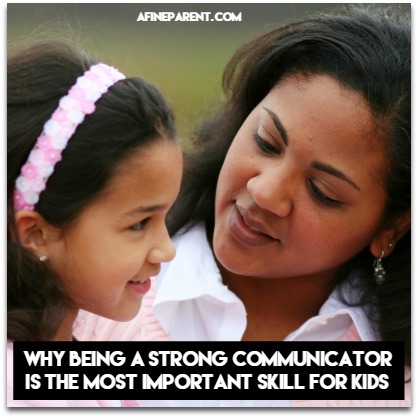
Why Being a Strong Communicator is the Most Important Skill for Kids“Let’s build a fort!”

“Yeah! Let’s do it outside in the back yard.”

“No, let’s just stay in here and do with the chairs and pillows.”

“No, come on, let’s go outside and we can use the tree as a base.”

“No, I want to stay inside and we’ll just use pillows. And these blankets.”

“If we are not doing it outside, I’m not building a fort.”

“Fine, I’ll build it without you!”

“Fine, I’ll build my own fort.”

With a heavy dose of tears, yelling, and slamming doors, this is what a Saturday morning sounds like in my house. Not every Saturday morning, but enough to make it clear that we have work to do.

More curious and compassionate communication – asking questions, active listening, working in groups – are key skills for every aspect of our lives – and ever more so in an increasingly complicated, interconnected and diverse world.

They are the tools for living fulfilled lives, for developing lifelong relationships. Employers regularly report that effective communication skills are integral to the success of their organizations – the stuff that makes strong leaders, collaborators, and teams. As my colleague likes to say, “training people to have challenging conversations is really only useful for those of us who have to deal with other people.”

[Read more…]

  • « Previous Page
  • 1
  • …
  • 55
  • 56
  • 57
  • 58
  • 59
  • …
  • 80
  • Next Page »

Disclaimers and Such:
Fair Warning: While none of this is professional advice, it is powerful stuff and could potentially change your life!
This site contains affiliate links. Pictures are either Creative Commons licensed or through Fotolia.
Click here to read our terms of use and privacy policy.