A Fine Parent

A Life Skills Blog Exclusively For Parents

  • Academy (Masterclasses)
  • Free Training
  • Articles
  • More
    • About This Site
    • Parenting Book Recommendations
    • Gift Guides
    • Contact

10 Essential Non-Verbal Communication Skills That Will Make You a Better Parent

by Michèle Gamzo.
(This article is part of the Be Positive series. Get free article updates here.)

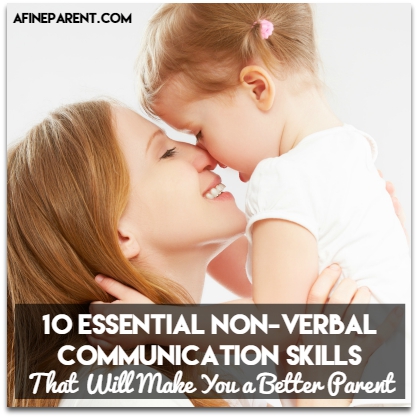
Non Verbal Communication Skills - Main PosterEver wonder when your little ones will finally follow directions?

Do you want to encourage your children to respond positively to what you say?

And how can you make them better listeners?

Even more so, how can you positively affect their communication skills?

As parents, we spend much time speaking and instructing our kids. Yet, how many of us have thought about the nonverbal ways we communicate with our children?

Eye rolls, smiles, arms crossed, shoulders hunched.

Nonverbal communication can have long-lasting effects on how they listen, behave, process information, and speak to others.  It also impacts their attitudes towards us parents and it affects how others see them.

Dr. Albert Mehrabian, author of Silent Messages, performed several studies on nonverbal language. He found that body language is a major aspect of communication. Who knew our physical mannerisms could speak such loud volumes?

Nonverbal communication may have serious effects on how well-liked a child becomes, and the types of opportunities offered to them in the future.

Bottom line: it can make them or break them.

As a mother of two and a speech-language pathologist, I’ve had to address this issue in a variety of ways.  My little boy, a toddler, responds much better to my ‘messages’ when I take a moment to alter my gestures in a way that he will be receptive and willing to hear me out.
[Read more…]

How to Handle Your Child’s Video Game Obsession Positively

by Christy Stillwell.
(This article is part of the Be Positive series. Get free article updates here.)

Kids Playing Video Games - Main PosterDo you live with a child obsessed with video games?
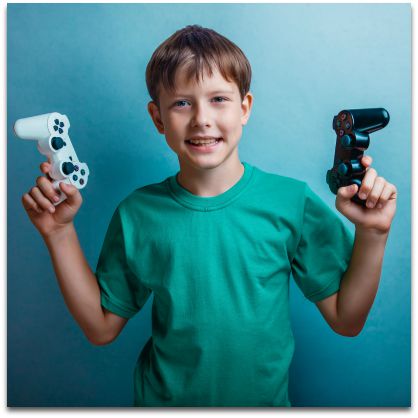
A kid who’d rather play Minecraft than ball?

Who would sooner build worlds in Terraria than accompany you to the neighborhood barbecue?

I took it hard, the day I finally admitted to myself that what most inspires my nine-year-old son is a video game.

Certain we were on the road to laziness, brain atrophy, and obesity, I went through a long spell of helicopter parenting: policing, nagging, and threatening.

My lowest move was to hide the iPad.

This was not a sustainable approach. It didn’t make the desire for video games go away. If anything, the deprivation increased the appetite. It made everybody feel bad.

I had to face facts: the world was against me in this fight. Laptops, iPad, iPod, smart phones, Xbox–this stuff isn’t going anywhere.

I needed a positive approach to video games, to screen time in general, a term meaning any time spent in front of a screen: games, movies, or movies of other kids playing games. The following strategies worked.

I now look at screen time as a fact of life. It doesn’t depress me that my kids like this stuff. I no longer believe that loving Minecraft means you are a lazy and dull person, irrevocably obsessed with video games and destined to suffer from nervous breakdowns or clogged arteries.

And most importantly, I don’t feel guilty about my changed beliefs.

Limits are the key. Start with your attitude: approach video games as one of many options in the vast tool bag containing cool things your kids get to do, rather than the evil monster that will take over your life.

The beast can be tamed. Here’s how.

#1 Accept that gaming is fun for your child, even if it’s not fun for you

Kids Playing Video Games - It is fun for themThose of us who did not grow up with the iPad, PlayStation, PC games and multitudes of devices wonder why anyone would want to spend down time in a two-dimensional world with no real plot.

Well, not a lot of us want to play tag for more than ten minutes, either.

Minecraft offers yet another opportunity to separate your experience from that of your child.

It isn’t your fault. The love of games did not come from your failure to expose them to sports or to read to them. They like what they like.

[Read more…]

How to Be a Positive Parent Even if You Weren’t Raised by One

by Amy Greene.
(This article is part of the Be Positive series. Get free article updates here.)

What is Positive Parenting - Main PosterDo you ever feel doomed to being just like your parents, even though you’re trying hard to do better?
I know how hard it is to try being a positive parent when you’ve been raised in a punitive home.

Like me, you may have grown up in a home where spanking, hitting, yelling, or shaming were the main “discipline techniques.” And now maybe you’re horrified to find yourself resorting to these techniques, too.

I lay SweetPea down on the floor to change her diaper. Immediately she twists her hips to flip over so she can crawl away. Clenching my jaw, I flip her on her back again and try to distract her with singing, but she is intent on reaching her activity center. Unbidden, the image of my hand slapping the soft, tender flesh of her thigh flashes through my mind.  I take a deep breath. I acknowledge my own frustration. I decide she and I both need a break from the struggle. “We’ll try again in a few minutes,” I say as I let her go and she happily crawls away.

My impulse to lash out comes naturally to me; I absorbed it from my parents. I’ve spent the last 15 years as a teacher and nanny learning how to react differently and overcome these unbidden impulses so that I don’t pass them on to my daughter.

The good news is that it doesn’t have to take you 15 years to start becoming a more positive parent! I’ll share with you how I healed from childhood wounds and techniques you can use now to re-write your parenting scripts.

Choosing a Better Way

Re-creating the same negativity is not our destiny; we can choose a better way to raise our own kids.

The question, of course, is how?

Despite our best intentions, the things our parents said to us often become the same dreaded words we say to our kids.

“Because I said so.” 

“Stop that crying right this instant.” 

“That’s it! No TV for you tonight.”

Like my momentary impulse to slap my daughter when she resists diaper changes, the way we were parented becomes our automatic default response.

But it doesn’t have to be that way. [Read more…]

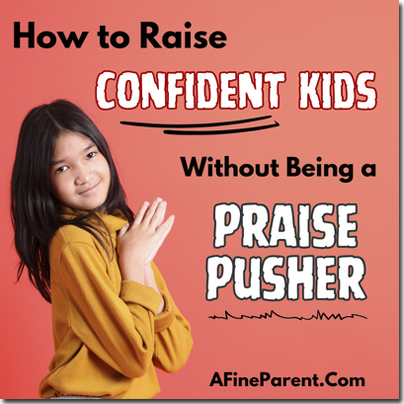
How to Raise Confident Kids Without Being a Praise Pusher

by Amy McCready.
(This article is part of the Be Positive series. Get free article updates here.)

“I’m so proud!”  “What a good girl!” “You are SO talented!”

So, there are worse things to say to your child – right?

Of course! But… there are better things to say to them as well, without trafficking in the kind of never-ending praise that sends our kids into a “need it, crave it, got to have it” almost addiction to getting patted on the back.

For many families it’s the beginning of a very slippery slope into entitlement that they find hard to reverse.

“But Amy, that’s what parents DO.”

I get it!

You think you’re helping them be more poised and self-assured, but left unchecked, you may be setting your kid up to be a person who needs constant “atta boys” from everyone around them to feel good about his own ability or choices.

Younger praise junkies may seek approval from parents and teachers.  “Do you like my singing, Daddy?”  “Was that a good shot?”

But when they’re older – their limitless need for affirmation can send kids gravitating towards their peers or the boyfriend/girlfriend for approval, and becoming the kind of entitled, high-maintenance people that most of us don’t really want to be around.

So, all good intentions aside, let’s start turning that praise junkie tide right now in your home with these three steps:

[Read more…]

The Deadly Character Flaw that Results in Misbehavior (And How to Deal With it)

by Heather Sanders.
(This article is part of the Building Character series. Get free article updates here.)

Character Flaw Pride - Main PosterYour kids say “Please” and “Thank you.”

They are kind, considerate and caring (most of the time). They respect others by listening when they’re speaking, and they share and take turns (usually).

You’re feeling pretty capable at this Parenting thing, and the truth is, you’ve done well – considerably well.

And then, you have a play date, and not only you but also your friends and half the neighborhood learns your child’s one defining character flaw.

Don’t worry. You’re still a fine parent, and now, you’ve been given your newest task on this parenthood journey of yours.

Oh, that bloodcurdling scream? That’s just my son.

My son Kenny was six years old the day his legendary growl ripped through the conversation I was having with my friend. We looked up to see him chasing her son down the street.

Horrified, I jumped down from the tailgate and took off after the two boys.

Catching up with my son, I grabbed him around his waist with a tight grip, swung him into my body, and plopped us both safely down on the curb.

He howled while pushing and shoving against me until I thought the blood vessels in his forehead and neck would burst. But, after a few minutes, my tough little guy’s yells and frustration gave way to sobs, and it was over as quickly as it started.

His friend, running wide-eyed back to his parents, obviously wanted to go home, and for good reason.

It isn’t every day that your friend turns into a wild banshee and chases you down the street.

What’s up?

Pride – a deadly character flaw raising its ugly head, both in Kenny AND his friends. That’s what.

As the story surfaced, I learned Kenny’s friend and his friend’s older brother had made fun of him. I can’t remember what it was about, but it punctured Kenny’s pride, and he acted out his rage.

While Kenny’s pride was easy to pinpoint (and hear), his friends’ pride was sarcastic and defensive, which was subtler than Kenny’s, though far from saintly.

After Kenny had settled down, I asked if he was ready to apologize; he wasn’t.

Sadly, he didn’t apologize at all that day, and our friends left early without the boys resolving their issues. I knew that once Kenny began missing his friends, his heart would warm to the thought of apologizing, but I also knew that’d take longer than a day.

It did.

Before it was all over, Kenny’s friends argued, “But it was just a joke.” while Kenny argued, “They made fun of me!”

Pride’s gongs rang loud and clear.

As parents, we prioritize building character into our kids’ lives, so naturally, when we see a character flaw like this, it makes us cringe.

We wonder how many times do we have to repeat the same lesson before our kid gets it?

Of course, you know the answer to that already — as many times as it takes.

The 9 “Faces” of Pride and How to Respond

Once you begin digging, you will find that pride is usually at the foundation of many of your otherwise well-behaved child’s sudden and often unexpected lapses.

Though pride presents itself in many ways, I’ve listed the 9 most repeated ways pride reared its head in my son’s life over the past 7 years and how we responded.

To be the positive parent you’ve always wanted to be, click here to get our FREE mini-course How to Be a Positive Parent.

[Read more…]

  • « Previous Page
  • 1
  • …
  • 59
  • 60
  • 61
  • 62
  • 63
  • …
  • 80
  • Next Page »

Disclaimers and Such:
Fair Warning: While none of this is professional advice, it is powerful stuff and could potentially change your life!
This site contains affiliate links. Pictures are either Creative Commons licensed or through Fotolia.
Click here to read our terms of use and privacy policy.