
A Fine Parent

A Life Skills Blog Exclusively For Parents

  • Academy (Masterclasses)
  • Free Training
  • Articles
  • More
    • About This Site
    • Parenting Book Recommendations
    • Gift Guides
    • Contact

Search Results for: journal

How to Raise a Super Hardy,
Resilient Child

by Amber Mae.
(This article is part of the Strong Kids series. Get free article updates here.)

Resilient Child - Main PicYou are really good at failing.

No, really. Do you remember the first time you fell off your bike? Failure.

What about that time you got that D on a test? Failure.

Your first kiss? Oh man, big time failure, or maybe that was just me.

See, really good at failing. Except, what makes a person good at failing isn’t the actual failure part, it’s the resiliency that comes after: picking the bike back up, studying harder for that next test, practicing on the pillow at home… oh wait, just me again.

Obviously not everyone is good at failing, but I’m willing to bet that you are. After all, you’re reading a parenting article to become a better parent. I could probably go so far as to say that failing, figuring out how to bounce back and emerging a better person for it are a part of your DNA.

So, here’s the question then: How can you pass this on to your child? How can you teach your child to be good at failure? How can you raise a hardy, resilient child who can face pretty much anything and come out the other end a heck of a lot stronger?

Raising a Resilient Child: The Epiphany

I remember my first experience with it very well. My oldest was two. I was watching her from the park bench and nursing her newborn brother when she fell and scraped her knee. I could see there was no blood, and she wasn’t going to need any first-aid, but I still felt torn as her little eyes welled up with tears.

“Mommy come kiss!” she pleaded.

I didn’t respond. How do you kiss a knee and breastfeed at the same time?

“Mommy kiss!” she repeated.

Necessity is the mother of all invention.

“Can you give it a kiss better?” I asked. That was her first lesson in resiliency.

Her little head cocked to the side as she pondered my question. The tears stopped. In a flash, she had kissed her own knee and was back on the playground as if nothing had happened.

At first, I felt guilty for my inability to be in two places at once, but after thinking about it I started to feel pretty good about myself and the inadvertent resiliency training I was doing. Of course, as I would quickly learn, there’s a lot more to teaching resiliency than simply kissing your own knee.

Here are some of the other things I’ve learnt along the way about raising a resilient child-

[Read more…]

How to Reduce Stress (And Protect Your Family From it For Good)

by Elizabeth Blake.
(This article is part of the Strong Kids series. Get free article updates here.)

How to Reduce Stress - Main ImageHave you ever noticed your kids reacting to stress in ways similar to yours? Have you taught them how to reduce stress?

For many of us, we resort to acting out our own unique version of the ‘fight or flight’ stress response. We might internally ‘argue’ with what is happening. Or we might shut down and resist dealing with it altogether.

For me, my subconscious response is to force my will upon the situation — not the best way to respond when you are trying to be a positive parent.

My 4-year-old son, who has a flair for delay, one day decided he simply must find his ‘very-special-one-of-a-kind’ blue button. I was trying not to be late to teach yoga class and with everything else that had been going on in my life at that time, I was in no mood to search the house to find a button. So, I put my foot down.

“No, we don’t have time to look for it now. We’ll find it when we get back.” I said.

“But, mommy, I need it!” He said in truth.

“It’s not that important. Come here please.”

“NO!” he yelled and stormed away in a desperate search.

“Get over here right now! I’m going to count! 1….2….”

You can see where this is going. A perfect storm of circumstances culminating in a power struggle of epic proportions. Never underestimate the will of a 4-year-old.

Stress is without a doubt one of the biggest banes of modern life. It lurks silently below the surface and sabotages the best of our intentions when we least expect it.

Luckily, there’s hope for all of us.

Stress is NOT Inevitable

[Read more…]

4 Simple Ways (Beyond Being a Role Model) for Teaching Kids How to be More Open-Minded

by Jenni Von Tobel.
(This article is part of the Strong Kids series. Get free article updates here.)

4 Simple Ways (Beyond Being a Role Model) for Teaching Kids How to be More Open-Minded - Main PosterHave you ever tried to lead by example with your kids…and totally failed?
I sure have!

While on vacation recently, we attended a breakfast to meet an esteemed colleague of my husband’s. They have an adult daughter with significant disabilities. After speaking with the mom for a while, I called my 5 year old daughter over to say hi.

But the minute she saw this woman in the wheelchair, she hid behind my legs. I tried to pry her fingers from me and make her say hello, but she refused.

You could see the fear in her eyes. And I was mortified. 

Here her father and I have devoted our lives to loving people with special needs and their families. To encouraging their parents and siblings. To spreading awareness about their abilities versus their disabilities.

And my own daughter was scared.

All she saw were the differences. The wheelchair. The drooling. The erratic movements.

I thought I was a decent role model and was leading my daughter by example. That she had watched me interact with all the students with special needs at my job and the way we accept and love all the kids with special needs at my husband’s work. I thought that our strong example would set the tone for her own response when it came to interacting with people with special needs.

Isn’t that what we are supposed to do as parents? Lead by example?

Maybe. But sometimes just being a role model is not enough.

Sometimes it’s the conversations that make the difference. That drives home the point. That allows the other person to ask questions, to explore their own doubts and fears and judgments. To bring to light topics that might otherwise remain hidden.

Thankfully, there are practical ways we can teach our children how to be more open-minded and choose to be inclusive. Here are 4 that have worked for me – 

[Read more…]

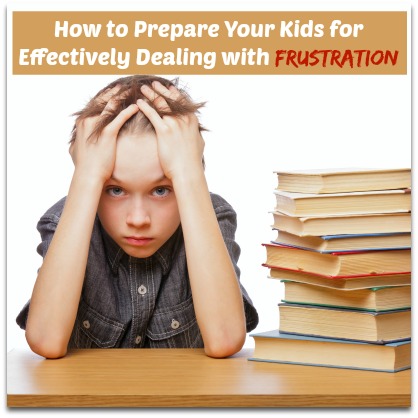
How to Prepare Your Kids for Effectively Dealing with Frustration

by Kerrick Lucker.
(This article is part of the Strong Kids series. Get free article updates here.)

Dealing With Frustration - Main PosterAmelia is having a problem.

I can tell from across the room, where I’m addressing another student’s question about their circuit project. Her face is getting redder and redder, her eyes are starting to get puffy, and she’s breathing very fast.

Amelia is eight, and every problem is the biggest problem of her life—even one as simple as a broken bit of copper wire.

I know what will happen next—if she doesn’t get to replace her wire right now, she’ll start to scream and sob uncontrollably. She might get out of her seat and throw her project materials on the floor.

In short, she’ll lose it and create an intolerable class disruption, all because her emotional response to momentary frustration is crashing out of control.

I’m worried for her, because unlike a broken wire, this emotional cascade can wreck her experience of school and jeopardize her future. Her panicky reaction to perfectly valid feelings of frustration can lead to behavior issues with real academic consequences.

Except today, Amelia takes a deep breath.

She slows down her breathing, and though I still see the edge of tears in her eyes, her face starts to return to its normal color. She puts up her hand and waits for me to call on her.

“I’m frustrated,” she declares. “My wire broke, and I can’t finish the circuit.”

“What can you do to fix it?” I ask her.

She thinks. I give her some time, letting the silence spool out for a minute or so. I see her frustration begin to shift into curiosity. She’s fidgeting with a bit of the aluminum foil we’ve been using to make very simple switches.

“If I wrap the pieces of wire together with some aluminum foil, will it make them work?”

“That’s a cool idea, Amelia. I like the way you’re thinking. Please try it and let the class know how it works, because I bet someone else will have the same problem and you could help them.”

Amelia is excited to have something to contribute. She has in fact found a workable solution—not the most elegant, but one of her own design.

Two weeks ago, this exchange would have been inconceivable.

[Read more…]

How to Remember to Be a Positive Parent Even When You’re Stressed

by Cally Worden.
(This article is part of the Be Positive series. Get free article updates here.)

Parenting Stress - Main PosterDo you ever find yourself wishing you could whip out a magic wand when your child is acting out?

I do this frequently. Especially when I’m stressed and tired.

In my mind’s eye, with an impressive flourish of the sparkle stick and a few random mysterious words, I have it all under control. I remove my pointy hat and cape and normal Mom service resumes. Smug smiles all round.

Then I snap out of my reverie and realize that my 4 year old has just released the wooden brick he was threatening to throw at his big sister. It is a millisecond from connecting with the side of her head. And I am two milliseconds away from having to switch from Magic Mom to Nurse-and-Disciplinarian Mom.

The ‘How do I deal with this?’ question in response to unacceptable behavior like this is usually followed by an instant decision fueled by the emotion of the moment.

But snap decisions aren’t always the best. In that moment of anger or frustration, our parenting sense is compromised. Our response comes from a place of internal conflict rather than from one of calm consideration. And it is often punitive as a result.

Fed up with yelling at my kids, I have recently been trying very hard to arrest my learned response of shouting and doling out punishment, choosing instead to actively employ positive, calm discipline.

In the wise words of Dr. Laura Markham at AhaParenting:

Think Loving Guidance, not punishment. Punishment is destructive to your relationship with your child and ultimately creates more misbehavior.

This is the basis of positive parenting. At an instinctive level, this idea resonates strongly with me. And in those moments of parenting calm and joyfulness, I even manage to muster up a fair impression of being that ideal positive parent.

But in times of stress, when snap decisions need to be made, I often flounder. I need something to ground me in those moments. A reminder of how to be that positive parent.

To be the positive parent you’ve always wanted to be, get our FREE mini-course How to Be a Positive Parent.

A solution presented itself during a word game with my daughter. We’ve been playing with mnemonics to help her remember things. Her favorite is Roy G Biv, where each letter acts as a reminder for the order of colors in the rainbow – Red, Orange, Yellow, and so on.

[Read more…]

  • « Previous Page
  • 1
  • …
  • 16
  • 17
  • 18
  • 19
  • 20
  • …
  • 23
  • Next Page »

Looking for Something Specific? Search Here…

Disclaimers and Such:
Fair Warning: While none of this is professional advice, it is powerful stuff and could potentially change your life!
This site contains affiliate links. Pictures are either Creative Commons licensed or through Fotolia.
Click here to read our terms of use and privacy policy.