A Fine Parent

A Life Skills Blog Exclusively For Parents

  • Academy (Masterclasses)
  • Free Training
  • Articles
  • More
    • About This Site
    • Parenting Book Recommendations
    • Gift Guides
    • Contact

How to Help Your Anxious Child Grow Up to Be a Happy Person

by Mindy Carlson.
(This article is part of the Positive Parenting FAQ series. Get free article updates here.)

Anxious Child - Main PicThat knot in the pit of your stomach?

That hand squeezing your chest?

That voice telling you this is all going to go horribly wrong?

That is anxiety, my friends.

It’s hard enough to deal with that feeling of dread and worry in myself, but it is heart breaking when my kids look up at me with big blue eyes full of worry and tears and tell me, “I just can’t do it, Mommy.”

Both of my boys have struggled with anxiety. My oldest was bullied in 2nd grade. The constant verbal assaults on him resulted in stomachaches, headaches, begging to be homeschooled, not sleeping, and going to the bathroom every 30 minutes. All are on the menu of classic symptoms of acute anxiety.

My youngest just seems to be a worrier. About once a week he comes out with some new thing to worry about. Currently his greatest worry is that he won’t make enough money from his art to support himself.  He is 6.

My kids aren’t alone in being anxious worriers. Every child experiences some anxiety. Before tests. At concert performances. The first day at a new school.

Anxiety and nervousness are normal as long as it doesn’t get in the way of their everyday lives. Once that happens it’s time to seek some professional support.

So, if your child is a worrier who does not need professional intervention, how can you help them process through these moments of chest-tightening, stomach-churning worry and learn to lead a calmer, happier life?

[Read more…]

Sense of Entitlement: How to Make Your Kids Immune to It

by Cally Worden.
(This article is part of the Positive Parenting FAQ series. Get free article updates here.)

Sense of Entitlement - Main PosterWhat would you do to make your child happy?
Quite a lot, no doubt.

But are you doing too much?

I know I am.

Not just in material terms, but in running after them, too. And I see that it makes my children happy. But I also see that in other ways it is inhibiting their growth as individuals.

My son is a natural giver. My daughter, more of a taker. No problem in itself–the world has space for all types of personality. It works on balance.

But the more I give, the more she expects. She is starting to feel a sense of entitlement. I see this on some occasions when I do say ‘No’. She looks confused, affronted almost.

And that’s partially my fault. Nature and nurture are coming together here to create the perfect storm.

Of course, there are some things my children are absolutely entitled to – My unconditional love. Nurturing. Respect. Food. Clothes. Shelter. A safe and happy home.

They deserve all of these things and more. I want them to know that they matter. That their contribution to the world matters.

The tricky part is learning where to draw the line between giving enough and giving too much.

I want my children to understand that the things they are entitled to are merely the foundation of their world. That as they grow, they have a responsibility to themselves and to others to give as well as take from life.

If they grow up with a sense of entitlement, thinking the world owes them something, then I’m not doing my job well. I’m not preparing them to take their place in life as a responsible, caring individual. And I’m holding them back from being the strong, capable, independent adults they deserve to be.

The entitlement trap is easy to fall into – we all want to make our kids happy. But by making a few simple changes to the way we coach them to conduct themselves in the world can make all the difference and keep the sense of entitlement at bay.

[Read more…]

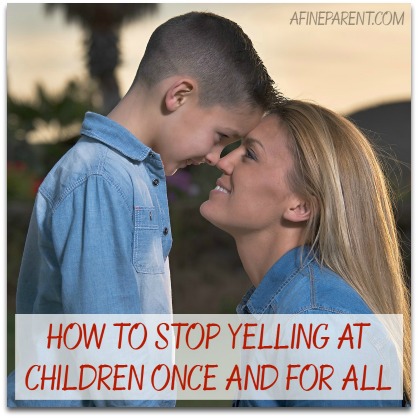
How to Stop Yelling at Children Once and for All

by Jennifer Poindexter.
(This article is part of the Stop Yelling at Kids series. Get free article updates here.)

Yelling at Children - Main ImageYou are doing it again!

Yelling at your children over big things, little things, and all things in between.

But why?

Why do we parents feel the need to yell when our point isn’t getting across?

Why do we have to resort to screaming to get our kids’ attention?

The reality is—we don’t have to. We are making rash decisions in difficult moments that are teaching our children bad habits.

Janet Lehman, a veteran social worker who she specializes in child behavior issues says:

“When chronic screaming becomes the norm, children are also apt to think it’s okay for them to scream all the time, too. You’re teaching your kids that screaming is a suitable response when you’re frustrated or overwhelmed. It doesn’t teach anything positive, just that life is out of control—and emotionally, you’re out of control.”

Wow—that hit home!

Believe me, I am not judging.

I was (probably) the world’s worst about yelling when my kids did something wrong, wouldn’t listen, talk back, seemed defiant — the list could go on and on.

I was a chronic yeller.

But I had a terrible wakeup call when I ended up in the middle of a feud that happened in my extended family. Though this person was totally out of line when making accusatory statements, one thing that was said to me was, “Well you’re a horrible mother because I’ve heard you yell a lot!”

Ouch!

What could I say? “No, I’m not a horrible mother! I am just human”? But I did yell a lot!

[Read more…]

How to Raise a Good Sport

by Mindy Carlson.
(This article is part of the Positive Parenting FAQ series. Get free article updates here.)

How to Raise a Good Sport - Main Good game, high-5; Good game, high-5; Good game, high-5; Good game, high-5…
At 8 years old, being a good sport was about hiding your disappointment when you lost and not bragging too much when you won. It was exhibited in a line of little girls delivering hand-slaps and “good games” before running to the coolers behind the bench to claim grape sodas.

As I got older, sportsmanship became about more than losing a game without throwing a temper tantrum. It became about handling yourself, on and off the field, with style and dignity no matter what the outcome.

Now I’m a parent with a super-competitive child and sportsmanship has never been more important.

My oldest has always been highly competitive. He needs to win. He must be first. Otherwise, he can get very frustrated. He has always been this way. In pre-school he used to bolt down as much food as he could and then say he was full, even though he had half his lunch left, so that he could be first to the washing up station.

This is terribly ironic considering that from the minute we decided to have children my husband and I were determined to raise our children to be non-competitive good sports.

None of this “Second place is the first loser,” or “Winning isn’t everything; it’s the only thing,” mentality for us. We emphasized fun over winning, asking him “Did you have fun?” before we asked anything else.

Yet here we are with a 10-year-old who will do anything to win – including cheat – and cries like his heart is broken when he loses.

Nature vs. Nurture. The struggle is real, y’all.

[Read more…]

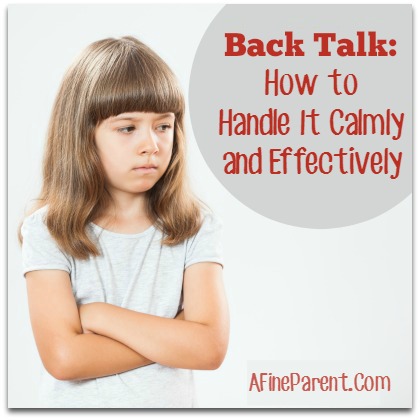
Back Talk:
How to Handle It Calmly and Effectively

by Cate Scolnik.
(This article is part of the Positive Parenting FAQ series. Get free article updates here.)

Back Talk - Main PosterDoes this sound familiar?

You tell your kids you’re all going to the store, and one immediately responds with a whiny “Whhhhhyyyy?”

You calmly explain that you need some groceries, and a response comes back immediately: “I don’t waaaaant to go! Sophie’s mom never makes her go grocery shopping!”

Managing to stay calm, you explain that different families have different rules and, in your family, you don’t do things the way Sophie’s family does. And then, you ask your kids to put on their shoes.

(Yaay for a calm positive parenting moments, right?)

But instead of being appeased and hopping up to put on her shoes your child responds back with “And Sophie gets twice as much pocket money as I do!”

What?

And in a matter of seconds, the conversation turns from pocket money to the ‘fact’ that everyone else at school has a mobile phone.

And you find yourself having a full blown argument over the necessity of a mobile phone for an eight-year-old!

How did that happen?

All I did was asked my kids to get ready to go to the store! And here I was embroiled in a completely unrelated power struggle with my child.

If you have a strong-willed child with a mind of their own, you know what I’m talking about…

They have an opinion about everything and a rebuttal for every request.

Talking back is a way of life for them – as natural, and perhaps as involuntary, as sneezing when pepper gets in your nose.

They don’t do it to be disrespectful. They do it because… that’s just who they are!

On the one hand, you don’t want to squash their spirit. After all, there are studies to show that kids who talk back are likely to be more successful in life.

On the other hand, you are only human. There is only so much back talk you can take. You can’t afford for every request to go to the grocery store to turn into a debate over something entirely unrelated.

I’ve been there and I know how you feel. And over the years, I’ve found a way to deal with back talk without being drawn into power struggles, and without squashing my child and her wonderful spirit.

Here are the 5 tricks I use –

[Read more…]

  • « Previous Page
  • 1
  • …
  • 49
  • 50
  • 51
  • 52
  • 53
  • …
  • 80
  • Next Page »

Disclaimers and Such:
Fair Warning: While none of this is professional advice, it is powerful stuff and could potentially change your life!
This site contains affiliate links. Pictures are either Creative Commons licensed or through Fotolia.
Click here to read our terms of use and privacy policy.